Header

Home     |     Fun     |     Movie Reviews     |     Recipes     |    Designs     |    History

Designs of Rangoli -1


3 Idiots remakes: Suriya replaces Mahesh Babu?


In the midst of rumours circulating that Ilayathalapathy Vijay and Prince Mahesh Babu are thinking of walking out of Shankar's Tamil and Telugu remakes of 3 Idiots due to various differences in opinion and date problems, it is now heard that Shankar has begun the search for apt replacements for the lead roles in Tamil and Telugu, and is likely to rope in either Suriya or Ajith Kumar for these roles.

Both Suriya and Ajith are always keen to work with Shankar, but it has to be seen if they will accept the 3 Idiots remakes!

Meanwhile, actor Vijay denied the reports that he has walked out of the 3 Idiots Tamil remake. He said he has not walked out, but is facing some date problems. He added that he had a talk with Shankar about this and the issues would be sorted out soon.

Tatia Tope - (1814-1857)


Tatia Tope was a hero of the Indian Mutiny which broke out in 1857 (which should more fittingly be titled as The 1st Indian War of Independence). His role in this achieved him international fame. Tatia was born in a place named Yeswale, near Nasik in Maharashtra. He was the second of eight children. His father’s name was Pandurand Pant. His own name was Raghunath. The Peshwa (Prime Minister) liked the bright boy, and on one occasion gave him a topi (hat) bright with jewels.

"Tatia" is a term of affection in Marathi. People near and dear to Raghunath used to call him Tatia, and because he always used to wear the hat, he acquired the name Tatia Tope, which was to stay with him till the end and beyond. The vast Maratha Kingdom fell in 1818. The disposed Peshwa, and some of his loyal people moved to Brahmavarta. Despite the loss of kingdom, the spirit of the young generation who lived in Brahmavarata was very much grounded in the memory of freedom and a desire to regain it. Many of Tatia’s young friends achieved fame as martyrs in 1857.

In 1851, Nana Saheb, adopted son of Baji Rao II, became Peshwa. He was a much more fiery character than his father and was happy with his family living comfortably on a British pension. Lord Dalhousie became the Governor of India, and was far more oppressive than his predecessors. He plundered India’s wealth, robbed young princes of their crowns, and brought in a large number of Christian missionaries with the express aim of eradicating the "vile culture of the land."

The flame of discontent in the minds of the people, who were born in free India, was ready for an insurrection. A careful plan was hatched to totally drive the British out of India. Tatia and others took the task of enflaming the hearts of the Indians fighting under the pay of the British (such soldiers were termed "sepoys"). It was ordained that 31 May 1857 was the date when many Indian regiments across India would simultaneously rise in revolt. But a famous unplanned incident set of the revolt 2 months before this date, in a costly but brave blunder. The Indian soldiers got the word that their new cartridges for their rifles were greased with cow fat and pig fat. This enraged Hindus and Muslims. A regiment in Barrackpore refused to load their rifles. The British were adamant and said that any soldiers who did not comply would be stripped of their arms. One Mangal Pande could not take these insults and fired at the British captain. The revolt was now on.

Other regiments joined the revolt and moved to the capital with the cry of "Chalo Delhi." They soon captured it. Nana Saheb and Tatia Tope bided their time. they were summoned to help the panicking British, in the city of Kanpur. There they called reinforcements, and at midnight on June 4th 1857 they struck, taking the city and booting out the British. For a time Kanpur was a stronghold of the revolt, but on July 16th the British called in reinforcements and retook it. The morale of the Indian soldiers began to flay. They couldn’t stand up to the superior technology and organisation of the British, and were demoralised that many of their countrymen did not join the freedom movement, particularly the Sikhs. Tatia Tope was entrusted with the momentous task of reinvigorating the Indians, which is when he really came into his own. 

Tatia went to Shivarajpur and gathered what forces he could. He fell upon the forces of General Havelock, who was marching from Kanpur to Lucknow, using the infamous guerilla techniques of the Marathas to inflict heavy losses. Tatia’s eyes then fell of Kalpi, which was strategically situated between Jhansi and Latehapur. The wrath of India descended upon the fortress and captured it. It was made into a workshop to manufacture arms. A new life was breathed into the War of Independence. In a swift swoop he captured a series of forts. He secretly reached the Scindhia regiment at Morar, whom he won over to the side of revolution, further reinforcing it. Then Tatia received the encouraging news that Major Windham of Britain, who was in charge of Kanpur was short of troops and resources. Not being one to miss an opportunity, Tatia collected his men, crossed the Jamuna and confronted Kanpur. A pitched battle was fought on the banks of the Pandu, which was eventually won. Tatia’s fame by now had reached all of Europe. His name was in nearly every newspaper. He was a household name of terror in England.

The British media were trying to portray him internationally as a vile evil fiend. True, he had affected the slaughter of a large number of British, but it was little compared with what Britain inflicted upon India, and indeed the other countries it was busy trying to colonise. Tatia Tope was a symbol of the indomitable spirit of India, a symbol of the reason why the Hindus out of all ancient peoples have survived through the long ages and continue to thrive even today.

However, the tide was to soon turn against Tatia and the rest of the rebels. The British retook Kanpur, but Tatia was beyond their reach, and arrived at Kalpi. He tried to again breath new life into the revolt, by trying to win over the native rulers and Princes to the side of freedom. However, most were scared. A few agreed to help in secret. Some stayed neutral. But others were actually rude and arrogant, insulting Nana Saheb, Tatia’s leader. Tatia resolved to teach these rulers a lesson, starting with the ruler of Charkhari. The ruler appealed to the British for help but the forces from Jhansi, commanded by Rani Lakshmibai blocked them, enabling Tatia to score a crushing victory, gaining money and ammunitions. But news of a crushing blow to the rebellion soon reached Tatia’s ears. Delhi fell, and its ruler, Bahadur Shah was taken prisoner. The forces at Delhi should have followed Tatia’s policy and continually harass the British without becoming complacent. But Bahadur Shah got too encouraged with the victory at the capital. This helped the British by allowing them to regroup, and gave them a single, unmoving target to attack. 

Still, the brave Rani Lakshmibai kept the flag of freedom flying at Jhansi. Tatia was very proud of the young girl whom he remembered as a child. Even Jhansi was soon besieged. Tatia answered the call for help, marching with a force, but it was of no avail. The remaining forces, including Rani Lakshmibai had to retreat to Kalsi. The rebellion was reaching its final stage, its spirit being gradually crushed. But not the spirit of Tatia Tope. He reached the kingdom of Gwalior, which was formerly part of the Maratha confederacy. He incited another revolt. Those ministers who opposed the revolt had to flee. It is said that Gwalior reverberated with war drums. But it was not to last. The British assault came and a grim battle was fought and lost by Tatia and the forces of Gwalior. Rani Lakshmibai fell in this battle. 

All the Indian rulers were now terrified into submission, but the British were not happy, as Tatia was still elusive. They never knew when he would incite another revolt. They launched a mammoth search for him for months. Tatia was now alone. The British offered "pardon" to Indian soldiers who gave up their arms. Many did so. At this hour of despair, Tatia remembered his old friend, Man Singh, a leader in the Gwalior army, who was now hiding with a band of men. Tatia had felt that Man SIngh was the one of the only men he could trust. Tatia was offered a place to stay and protection. The British had caught scent of Tatia’s plan. They contacted Man Singh, offering him pardon, riches and land. The temptation could not be resisted and thus Man Singh was won over. 

It was midnight of April 7th 1859 when the lion was caged, in his sleep. Tatia Tope was put on trial, at the camp of General Meadle at Shivpuri. Tatia scoffed at the charges against him. "I am not your servant. I have obeyed the orders of my Peshwa, who is my master. I have shed no innocent blood. I do not ask for any mercy...blow me to pieces on the mouth of a cannon or hang me to death from the gallows."

On April 18th 1859, 2 years after the outbreak of the war, Tatia was hung. He was totally undaunted and unbroken at the time of death. He even put the rope around his own neck to show how unphased he was. He had fought more than 150 battles. Thus passed a very brave and heroic Indian, who lived and died as a lion. 


Jnanadeva - ( 1275-1298)


Jnanadeva of Devagri (Maharashtra) lived late in the 13th during the rule of King Ramadevarao, immediately prior to the Islamic invasions of that part of India. He lived for an all too brief 22 years and left a rich body of spiritual writings [Amritanubhava, the Abhangas, the Jnanesvari and the Changadeva Pasashti]. Biographical details are sketchy. It seems Jnanadeva lived approximately 1275 to 1296. Some scholars allege some attributed works are written by two different persons of the same name; there are two tombs [or Samadhi] in existence for Jnanadeva, which further confuses historical data. Jnanadeva translated the Bhagavad Gita into Marathi and provided a magnificent commentary that is richly illustrated with idiom, metaphor, simile and homely example. His principal work, the Jnanesvari was named Bhavartha Deepika (Light on the Inner Meaning); however it goes by the name "the Jnanesvari" in honour of his name, Jnanadeva. His works charged the entire region of Maharashtra with devotion and wisdom.


Jnanadeva inspired other saints that followed him - Namadeva, the tailor's son, Narahari, the goldsmith, Gora the potter, Chokamela and his wife, who were from a very low caste and Janabai, the maid servant, and so on. He was the pioneer of the Abhanga tradition, and of the Varkari tradition, the annual pilgrimage to the sacred Vittal Mandir of Pandaripur. In the ceturies which proceeded his life, the seed which he created blossomed and many other great seers and upholders of Hinduism in that land came forth, such Eknath, Tukaram and Ramdas. It is not inaccurate to say that the great political renaissance of Hinduism that occurred in Maharasthra which was the first reggion to decimate the Moghuls owes much to the renewed faith in people's hearts that was imparted by Jnanadeva, some centuries earlier.


Jnanadeva voluntarily left his body for union with the Divine in Alandi, near Poona in 1296 at the age of 22 (25 by some other scholars). He had done what he had come to do in his birth. He took his last bath, and descended the steps into the Samadhi that had been prepared for him. Sitting in the padma position and facing North, he voluntarily released his mortal coil. 


------------------------------------------------------------------------------------------------------------------------


For a longer biography, which includes some of his teachings, please go to the following page:


http://www.geocities.com/ganesha_gate/jnanesh.html

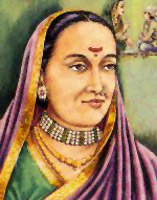
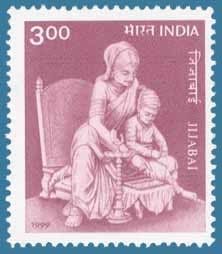
Jijabai, Mother of Shivaji


Jijabai was the mother of Shivaji perhaps the most famous and succesful Hindu warriors of the medieval age. The life of his mother, Jijabai, is no less inspiring or sacred, and takes a proud place in our history. 


Her father, Lakhuji Jadhav Rao, was an important leader serving under the Muslim Nizamshahi administration. During those days, many Hindu leaders of that region were serving under the Nizam. They had small armies of their own and had obtained lands, high position and ranks under the Nizam. But they hated one another and were always trying to increase their power and prestige at the expense of one another. 


It was Holi, and Jijabai's father was holding a celebration at his hall, where many were assembled. Shahji, son of Maloji (who was serving under Jadhav Rao) the future husband of Jijabai was present. Shahji and Jijabai were still small kids. Jijabai poured coloured water over Shahji and Shahji did likewise. Jadhav Rao liked the boy, and drew him and his daughter to his side, and jokingly said "don’t you think these 2 make a great couple?" Everybody agreed. Maloji, who was watching, got up and said "Noble men, did you hear what our Jadhav Rao has said? Henceforth we are related to each other as parents of the bride and bridegroom!" But this was not what Jadhav Rao had in mind. He was in too high a rank compared with Maloji. He harshly rebuked Maloji, who was gravely insulted. Maloji left the hall, feeling embarrassed at the public spectacle.

In the following months, Maloji was deeply troubled. He was unsure of what next step to take in life. For a while he went back to tilling the fields, but he was sorrowed. One night, it is said that Maloji had a strange dream. The Goddess Bhavani appeared before him in dazzling splendour and advised him not to sulk, but strive hard in life, as a hero and bringer of a new era was soon to be born in his family. The next day in the field, late at night, he once again felt the presence of Bhavani, who advised him to dig at a certain spot. He did so, and unearthed 7 pots of treasure. However he was actually led to the treasure, its acquisition was to have an important bearing on India’s future. Maloji brought a unit of 1000 cavalry, and infantry. He provided security to the people, and to traders, and in doing so grew increasingly wealthy.

With his money, he dug wells, built lodges for travellers, fed the needy and renovated temples. His power and prestige grew, and more men began to serve under him. Maloji had not forgotten Jadhav Rao’s words. He was still insulted, and began to press him to allow Jijabai and Shahji to marry. Jadhav Rao refused, but Maloji resorted to intense pressure, and invoked the Nizam’s mediation, forcing Jadhav Rao to comply. Jijabai and Shahji were married. But Jadhav Rao developed a hatred for Maloji’s family, the Bhonsles. Shahji grew up as a renowned general and served the Nizam. Jadhav Rao joined the Moghuls (who were opposed to the Nizam) in order to harass Shahji, which he spent his life trying to do. This deeply troubled Jijabai. She was also unhappy that both her father and her husband were serving under Muslim sultans, who she saw as marauders. 


She cared not for the riches that this service could bring. It was liberty she loved. 


In the meantime, the Moghuls invaded the Nizam’s dominions. Shahji was entrusted to look after the fort of Mahuli and Jadhav Rao joined in the attack. After 6 months resistance, Shahji had to evacuate the fort, with Jijabai, who was then 4 months pregnant. Jijabai got to Shivaneri, where she gave birth to Shivaji. 

She used to pray, while pregnant in the temple of Jagadamba: "O Mother of the Universe, give me some of your strength. Put an end to the pride of the Marathas in the shameful service to the Muslims. Grant our lands independence. Grant that my wish be fulfilled, O Mother." She was angered at being around men whom could not protect their women, children, country and religion. She longed that her son may be part of a generation who could do this. She studied the intricate political problems of the country, in the company of experienced politicians and diplomats. She could see people falling into poverty in the once rich land and could see the culture which she loved so much being disintegrated. If only a leader could be born who could unite the scattered Hindus. It was ordered that while she was pregnant, every comfort be conferred upon her. But she wished for none of it. Rather, she wanted to climb to the tops of forts on hills, to wield swords, to discuss political questions, to put on armour and ride on horse back. 

It has been said in ancient Hindu culture and is a proven fact today, that the pregnant mother, by the environment she provides, by the thoughts she thinks, and by what she wishes for her unborn child, does a tremendous amount to shape the childs life for good or bad. In Vedic traditions, there are a series of sacraments and chants to be carried out as to optimise the child’s potentials. Jijabai infused in Shivaji such a spirit, that was to emerge with great force throughout his life.

Then, the most crushing news struck Jijabai like lightening. Jadhav Rao, her father, who had recently been readmitted to the service of the Nizam, had been beheaded, together with her entire family. It is probable that the Nizam thought the Marathas were getting influential. Her husband too was in danger of meeting a similar fate, but he was shrewd and joined the Moghuls. Jijabai’s fiery spirit was set ablaze by the slaughter of her family. In the time that followed, whole villages of Marathas were wiped out. A Maratha princess was carried away while bathing. At one time Jijabai herself was kidnapped, as a bargaining chip. Such were the times in which she lived. But instead of frightening her, it just strengthened her resolve that an independent protector of the Hindus was an urgency. She brought up her son with a love of liberty infused in him. They lived at Pune, under the protection of Dadaji Kondev. Jijabai was one of the main administrators at Pune. She was educated, able and wielded great authority (not adhering to the myth of the "oppressed Hindu woman of medieval India"). When they arrived, Pune was a small village that had been consecutively ransacked by the Nizam, Adil Shah, and the Moghuls. Each and every Hindu shrine had been smashed. But soon Pune flourished, with the help of Jijabai. Jaijabai restored the shrines, and on many occasions settled disputes and metted out justice. She was responsible for most of Shivaji’s education. She had him learn in detail the lessons from the Mahabharata and the Ramayana. He learnt about the holy scriptures and arts of administration and weaponry, and the political situations in the land. 

Shahji married a second wife, Tukabai, and spent most of his time with her and her son. The effect this had on Jijabai, nobody can tell. Jijabai did not lose heart, and concerned herself as before, with admistration, bringing up Shivaji and in long periods of prayer and meditation. Jijabai even set the scenes for social reforms in Hindu society. To quote an example, on her advice, the brahmins allowed a soldier named Balaji Nimbalkar to re-embrace Hinduism after converting to Islam. In those days, many people were opposed to such a move, an attitude which to some extent persists today. But Jijabai could see that because Hindus created a system whereby people could leave the Hindu fold, but not enter it (which had no basis in the scriptures), Hindu society had been weakened. Jijabai impressed upon everybody the logic of this position. Further more, showing that she was genuine in her view, she gave Shivaji’s daughter Sakhubai in marriage to Balaji’s son. 

While Shahji and Dadaji were worried when Shivaji, at the age of 16 first captured a major fort, Jijabai was overjoyed. When Afzal Khan, the renowned general of Bijapur came with a large army to crush Shivaji early in his career, Shivaji turned to his mother, who unlike others told him to face the danger resolutely. Shivaji’s army was tiny by comparison, but by biding his time and using lightening guerilla techniques, he worsted Afzal Khan’s army. When at a private meeting, Afzal Khan tried to kill Shivaji, Afzal Khan ended up dead. This episode greatly increased Shivaji’s prestige. 


Jijabai treated Shivaji’s companions as her own sons, and was a source of courage and inspiration to them. Tanaji Malasure is one such renowned example. He lost the fort of Simhagadh to an intense Moghul attack. She famously told him "if you free Simhagad from the enemies you will be like Shivaji’s younger brother to me." Tanaji went forth, for what others advised to be mission impossible, and succeeded, but was martyred in the process. Jijabai was watching from her fort all night. When she saw the saffron flag of the Marathas ascend on the fort, she cried with joy. But shortly after she received the news of Tanaji’s death, she began to cry with pain and could not be consoled. Another hero, Baji Prabhu, a childhood friend of Shivaji, fought with great valour to save Shivaji’s life, and in doing so died. On hearing the news, Jijabai rather than being comforted that her son was safe wept as if she had lost her own son.


In her life Jijabai had to bare sorrow after sorrow, and did it bravely for her country and religion. She reflected the glory and strength of Mother Durga. We hope her life will always be remembered with reverance. In 1674, Shivaji held a vast ceremony, declaring himself an independent ruler. Jijabai was present at the ceremony. What joy she must have felt attending the ceremony - everything she had lived for had finally bore fruit. 12 days later, Jijabai died.

Ramana Maharshi - (1879-1950)


His Significance
Ramana Maharshi is universally looked upon as one of the greatest self realised sages of modern times. He lived a quiet life with no interest in publicity, yet seekers flocked to him and today many centres bearing his name exist all over the world. He was renowned for his saintly life, for the fullness of his self-realization, and for the feelings of deep peace that visitors experienced in his presence. So many people came to see him at the holy hill of Arunchala where he spent his adult life that an ashram had to be built around him. He answered questions for hours every day, but never considered himself to be anyone's guru. 


Early Life

Ramana was born on 30 December 1879 in a village called Tirucculi about 30 miles south of Madurai in Tamil Nadu, India. His middle-class parents named him Venkataraman. His father died when he was twelve, and he went to live with his uncle in Madurai, where he attended American Mission High School. At age 16, he heard somebody mention "Arunachala." Although he didn't know what the word meant (it's the name of a holy hill associated with the god Shiva) he became greatly excited. At about the same time he came across a copy of Sekkilar's Periyapuranam, a book that describes the lives of Shaivite saints, and became fascinated by it. In the middle of 1896, at age 16, he was suddenly overcome by the feeling that he was about to die. He lay down on the floor, made his body stiff, and held his breath. "My body is dead now," he said to himself, "but I am still alive." In a flood of spiritual awareness he realized he was spirit, not his body.


His Guru 

Ramana Maharshi didn't have a human guru (other than himself). He often said that his guru was Arunachala, a holy mountain in South India.


His Teachings 

Ramana Maharshi taught a method called self-inquiry in which the seeker focuses continuous attention on the I-thought in order to find its source. In the beginning this requires effort, but eventually something deeper than the ego takes over and the mind dissolves in the heart center. The seeker then experiences the truth off their being beyond the body, and beyond time and space. The goal of realisation of the divine within us and to merge back into the sea of consciousness where there is only pure bliss and awareness is the main ultimate goal of all paths within Hinduism. Ramana Maharshi taught one of the most structured and direct paths to it. He included the aids of worship of deities, Vedic chanting, reverence for the divinty in nature, action performed surrendered fully to God all as part of the progression to pure realisation.


A brief but extremely meaningful summary of his teachings (the Upadeshasaram composed by Ramana, consisting of 30 verses together with a short commentary) can be found at the following link:


http://www.vedanet.com/Upadesha.htm

Mira Bai (c.1498-1546)


There are few Hindus who will not have heard of Mira bai, the Rajput princess whose devotional compositions have provided a voice to the spiritual yearning of millions, and have a distinct, even a feminist, emphasis to them. Many stories exist about Mira, and it is difficult to produce a factual account of her life, although she lives perpetually through her songs, famous throughout India/ The following is a shortened account about popular folk-lore about Mirabai:

Born in Rajisthan a land of warriors and sages, sadhus and kings, but also instability and sorrow, Mirabai showed great devotion for Lord Krishna in her childhood years. One day, a holy man came to her family’s palace and was carrying a small image of Krishna. Knowing that Mirabai would appreciate it, her mother brings her the little statue of Krishna. As the wandering sage left the palace he took his image of Krishna with him. Mira bai was very upset – in fact for days she lost her appetite and was very sad. But after a few days the sadhu returned. The night before, he explained, Krishna had appeared to him in a dream, telling him to return the image to Mira!

Mira grew up to be a beautiful young lady, and was duly married to the warrior Prince Bhoj, and went to live at his palace. However, despite being a devoted and dutiful wife, devotion to Lord Krishna was always foremost on her mind, which annoyed the family of her husband. Uda, her sister in law was most annoyed at Mira’s ways. They tried to stop her from visiting the temple. Prince Bhoj came to accept his wife’s nature, and thought of her as a great devotee of the Lord. He built her a small Krishna temple within the palace. However, for company with other devotees, Mira still sought to go to the village temple. She became acquainted with the great saint Ravidas, who was a humble shoemaker by profession, and learnt much about aspects of religion that she did not know about through him. She considered Ravidas her spiritual preceptor (Guru).

Although her in-laws were becoming enraged with her behaviour, several of them could see their was something very special about her. Ravidas is turn was very impressed and moved by the intensity of her devotion to Krishna. He brought her a sitar with his own meager resources, which she used to compose and play soul stirring devotional songs to all who would listen. Through her songs Mirabai’s fame grew exceedingly, spreading far and wide throughout India. Even the Moghul Emporer Akbar came to visit her, and was so moved by her songs that he gave her a precious necklace.


Meanwhile, Prince Bhoj, Mirabai’s husband was killed in battle, against the predatory Moghuls. Bhoj’s cousin seizes the throne, who was one member of the family who had harboured dislike for Mirabai. Finding Akbar’s necklace, he accused Mirabai of being a traitor. He confined her to her room, and ordered her precious image of Krishna to be thrown into the river. She still had her devotion to Krishna, but was distraught at not being able to be amongst her fellow devotees and resented being locked in a confined space. She is believed to have write to Tulsidas, who advised her to attempt to leave, which Mira bai did so. Mira’s sister-in-law, Uda had grown fond of Mira over time and was very saddened by Mira’s departure.

Mira roamed India in devotion to her beloved Lord Krishna. She could see Krishna everywhere and in everything, and her songs describe her rapture in this vision. She grew very famous and loved. This enraged the king, the cousin of Mira’s husband Bhoj’s. He was determined now that Mira should die. Many attempts were subsequently made on Mira’s life, none of which bore fruit, due to her unfathomable love and trust in Krishna.